
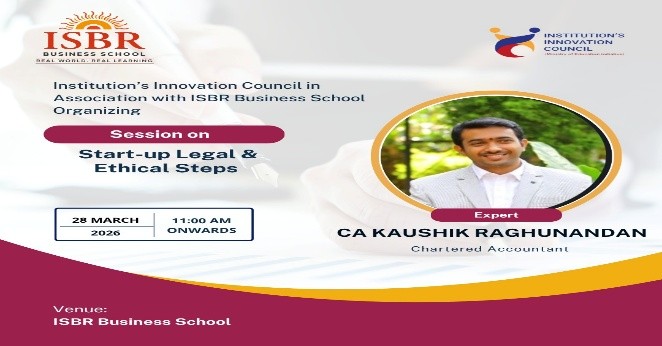
Startup Legal and Ethical Steps are essential for entrepreneurs who want to build sustainable, compliant, and successful businesses. Understanding startup compliance requirements, business structure selection, taxation, and ethical decision-making can significantly reduce risks and improve long-term growth. To strengthen these critical competencies, the Institution’s Innovation Council (IIC) at ISBR Business School organized an expert-led session focused on the legal and ethical foundations of entrepreneurship.
Understanding Startup Legal and Ethical Steps
Entrepreneurship is not just about innovation and business ideas. It also requires a clear understanding of legal obligations, regulatory compliance, and ethical responsibilities. Recognizing this need, the Institution’s Innovation Council (IIC) conducted an insightful session titled “Start-up Legal & Ethical Steps” to prepare aspiring entrepreneurs for real-world business challenges.
The session was facilitated by CA Kaushik Raghunandan, a distinguished Chartered Accountant with extensive expertise in startup regulations, taxation, and business compliance. Through practical examples and structured explanations, he simplified complex legal concepts and enabled participants to understand the critical legal framework required for launching and managing a successful startup.
Startup Compliance Requirements and Business Formation
One of the key highlights of the session was the detailed discussion on various business structures available to entrepreneurs. Participants gained valuable insights into:
Sole Proprietorship
A sole proprietorship is one of the simplest forms of business ownership. The session explored its registration process, taxation framework, and personal liability implications.
Partnership Firm
Participants learned about partnership agreements, profit-sharing mechanisms, legal responsibilities, and compliance requirements associated with partnerships.
One Person Company (OPC)
The session explained how an OPC combines the benefits of a corporate structure with single ownership, making it suitable for solo entrepreneurs seeking limited liability protection.
Private Limited Company
A popular startup structure, the private limited company model was discussed in detail, including registration procedures, corporate governance, fundraising potential, and compliance obligations.
Public Limited Company
The resource person also highlighted the characteristics of public companies, regulatory requirements, and opportunities for large-scale business expansion.
Through these discussions, participants developed a clear understanding of business structure selection, enabling them to make informed decisions based on their entrepreneurial goals.
Entrepreneurial Legal Framework and Taxation Essentials
A strong entrepreneurial legal framework is essential for business sustainability. During the session, students explored:
- Company registration procedures
- Regulatory approvals and documentation
- Startup taxation requirements
- Legal compliance standards
- Liability and risk management
- Corporate governance principles
The practical approach adopted by the speaker helped participants understand how legal compliance can serve as a strategic advantage rather than merely a regulatory obligation.
Ethical Entrepreneurship: The Foundation of Sustainable Startups
A major focus area of the session was the role of ethics in entrepreneurship. Participants learned that legal compliance alone is not sufficient for long-term business success. Ethical business practices create trust among customers, investors, employees, and stakeholders.
Key ethical principles discussed included:
- Transparency in business operations
- Accountability in decision-making
- Fair business conduct
- Regulatory adherence
- Responsible stakeholder management
- Integrity in financial reporting
Real-world startup case studies and examples illustrated common ethical challenges faced by entrepreneurs and highlighted practical approaches to addressing them effectively.
Interactive Learning Through Business Structure Analysis
To reinforce theoretical concepts, the session incorporated a collaborative group activity. Participants were divided into teams and tasked with analyzing different business structures based on:
- Registration procedures
- Taxation requirements
- Liability considerations
- Compliance obligations
- Ethical responsibilities
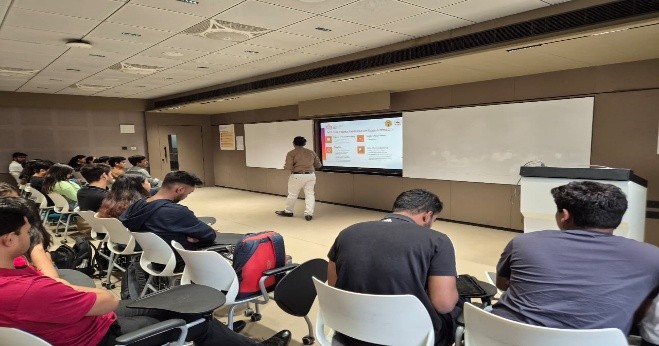
This hands-on exercise encouraged critical thinking, teamwork, and practical application of startup legal and ethical principles. Students actively engaged in discussions, compared different business models, and presented their findings, creating a dynamic learning environment.
Key Learning Outcomes : Advancing Responsible Entrepreneurship Through Innovation
The session successfully achieved its objectives by enabling participants to:
- Develop a strong understanding of startup legal structures.
- Gain awareness of startup compliance requirements and regulatory obligations.
- Understand ethical responsibilities in entrepreneurship.
- Differentiate between various business entities and their legal implications.
- Apply legal and ethical principles through practical group activities.
- Strengthen decision-making capabilities related to business formation.
- Foster responsible and compliant entrepreneurial practices.
- Align innovation initiatives with integrity, transparency, and governance standards.
The Institution’s Innovation Council continues to play a pivotal role in nurturing future-ready entrepreneurs by bridging the gap between innovation and compliance. Sessions such as “Start-up Legal & Ethical Steps” equip students with the knowledge, confidence, and ethical mindset required to navigate today’s evolving business landscape.
As the startup ecosystem continues to evolve, such initiatives contribute significantly to creating a generation of entrepreneurs who prioritize innovation, accountability, and sustainable business growth.
About ISBR Business School: ISBR Business School, located in Bangalore, India, is a premier institution dedicated to providing world-class education in business and management. Accredited by the NBA and recognized by the Association of Indian Universities and the Ministry of HRD, Government of India, ISBR has consistently been ranked as a platinum institute by AICTE-CII. With a diverse student body, a strong emphasis on industry collaboration, and a curriculum designed to foster innovation and leadership, ISBR Business School is committed to shaping the business leaders of tomorrow. The school’s robust placement record and partnerships with top global companies underscore its commitment to excellence and career readiness for its students