
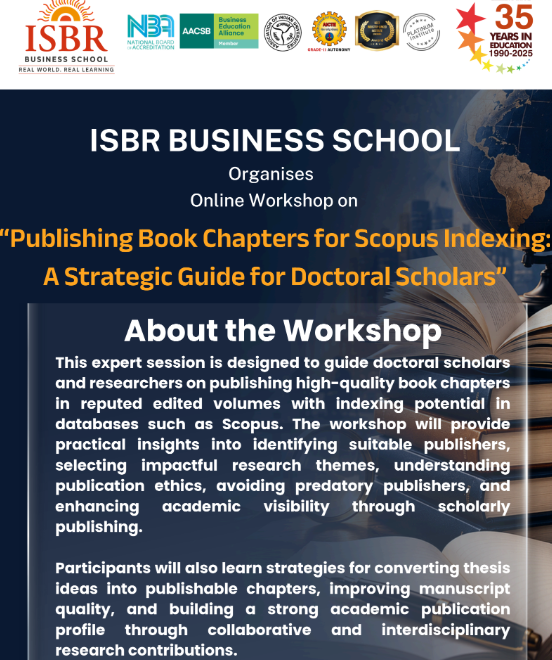
Scopus Indexed Book Chapter Publishing is becoming an essential strategy for doctoral scholars who wish to increase research visibility, build academic credibility, and expand global collaborations. Understanding how to publish in internationally reputed edited volumes can significantly improve citation impact and strengthen a researcher’s publication portfolio.
Recognizing this growing need, ISBR Research Center successfully organized an online workshop titled “Publishing Book Chapters for Scopus Indexing: A Strategic Guide for Doctoral Scholars” on 31 May 2026. The workshop equipped doctoral scholars, researchers, and academicians with practical knowledge on publishing high-quality book chapters in globally recognized publications while maintaining the highest standards of academic integrity.
Why Scopus Indexed Book Chapter Publishing Matters
Publishing a book chapter in a Scopus-indexed publication offers several advantages for researchers:
- Enhances global research visibility
- Improves citation potential
- Strengthens academic profiles
- Supports career progression in academia
- Increases opportunities for international collaborations
- Demonstrates research excellence through reputed publishers
For doctoral scholars, publishing in Scopus-indexed edited books serves as an important milestone that complements journal publications and showcases expertise in specialized research domains.
Initiative Towards Research Excellence
The workshop was conducted by Dr. Anand Shankar Raja M., Associate Professor, ISBR Business School, an accomplished academic with extensive experience in Scopus-indexed publications, research mentoring, and scholarly publishing.
During the session, participants explored the complete ecosystem of academic publishing, beginning with the fundamentals of book chapter preparation and progressing toward publication in internationally reputed edited volumes. The workshop focused on enabling scholars to confidently navigate the publication process while aligning their research with global academic standards.
Understanding Scopus Indexing and Academic Publishing
One of the major highlights of the workshop was understanding the role of Scopus indexing in increasing research impact.
Participants learned about:
- Importance of ISBN and DOI systems
- How Scopus indexes scholarly publications
- Benefits of publishing with internationally reputed publishers
- Strategies for selecting suitable edited books
The session also introduced scholars to globally recognized publishers including:
- Springer
- Taylor & Francis
- Emerald Publishing
In addition, participants explored trusted academic platforms such as:
- ResearchGate
- WikiCFP
These platforms help researchers discover international calls for book chapters aligned with their areas of expertise.
Transforming Doctoral Research into Publishable Book Chapters
Publishing research requires more than simply converting a thesis chapter into a manuscript.
The workshop provided practical strategies for:
Selecting High-Impact Research Topics
Participants learned how to identify research problems that align with current global academic discussions and emerging interdisciplinary themes.
Developing Strong Conceptual Frameworks
A well-structured conceptual framework improves the quality and scholarly contribution of a book chapter while strengthening its acceptance potential.
Enhancing Manuscript Quality
Key recommendations included:
- Clear research objectives
- Logical organization
- Strong literature review
- Effective academic writing
- Proper referencing
- Consistency in formatting
Responding to Reviewer Feedback
Constructive peer review is an integral part of scholarly publishing. Scholars were guided on responding professionally to reviewer comments while improving manuscript quality for successful publication.
Publication Ethics in Scopus Indexed Book Chapter Publishing
Maintaining academic integrity remains fundamental to successful research publishing.
The workshop emphasized several ethical dimensions of scholarly communication:
Preventing Plagiarism
Researchers were encouraged to produce original work while appropriately acknowledging all scholarly sources.
Responsible Use of Artificial Intelligence
Participants discussed ethical applications of Artificial Intelligence in academic writing, ensuring technology supports research without compromising originality or authorship.
Authorship Ethics
The session highlighted fair authorship practices, contributor responsibilities, and transparent collaboration among researchers.
Copyright and Licensing
Understanding copyright policies helps researchers protect intellectual property while complying with publisher requirements.
Identifying Predatory Publishers
Scholars also learned practical methods to identify predatory publishers and avoid unethical publication practices that may negatively affect academic credibility.
Building a Strong Academic Research Profile
Publishing high-quality research is only one aspect of academic success.
The workshop encouraged participants to strengthen their professional visibility through researcher identity platforms, including:
- Google Scholar
- ORCID
- Scopus Author ID
- ResearchGate
Maintaining updated academic profiles improves discoverability, networking opportunities, citation tracking, and international research collaborations.
Interactive Learning and Publication Planning
The programme concluded with an engaging discussion where participants interacted directly with the resource person on topics such as:
- Publication planning
- Scopus indexing timelines
- Selecting appropriate publishers
- Improving citation impact
- Building long-term publication strategies
The interactive format allowed doctoral scholars to receive practical guidance tailored to their individual research journeys.
About ISBR Business School: ISBR Business School, located in Bangalore, India, is a premier institution dedicated to providing world-class education in business and management. Accredited by the NBA and recognized by the Association of Indian Universities and the Ministry of HRD, Government of India, ISBR has consistently been ranked as a platinum institute by AICTE-CII. With a diverse student body, a strong emphasis on industry collaboration, and a curriculum designed to foster innovation and leadership, ISBR Business School is committed to shaping the business leaders of tomorrow. The school’s robust placement record and partnerships with top global companies underscore its commitment to excellence and career readiness for its students