
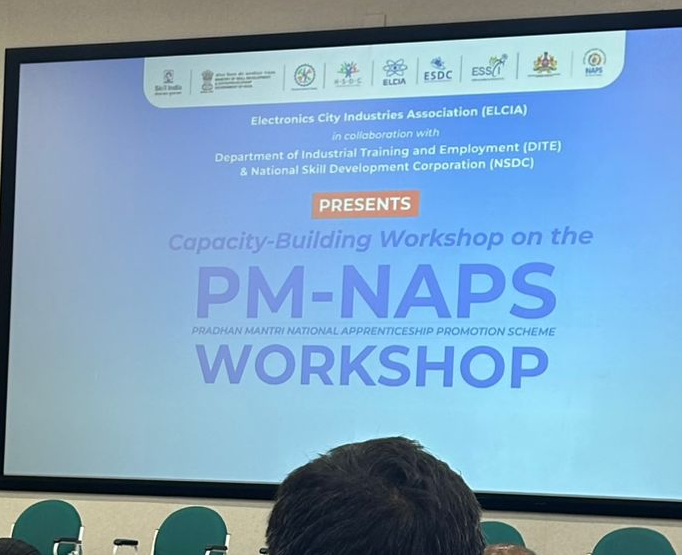
The PM-NAPS apprenticeship workshop hosted at the International Institute of Information Technology Bangalore (IIIT-B) brought together leading academic institutions, industry leaders, and policymakers to strengthen apprenticeship training in India. Organised by the Department of Industrial Training and Employment (DITE) in collaboration with the National Skill Development Corporation (NSDC), the workshop focused on promoting the Pradhan Mantri National Apprenticeship Promotion Scheme (PM-NAPS) as a strategic initiative for workforce development.
ISBR Business School participated in the workshop to engage with industry experts and government stakeholders on strengthening apprenticeship programmes. The event provided valuable insights into how academic institutions can collaborate with industry to develop job-ready talent through structured apprenticeship training. The session was attended by Dr. Rajani Pillai – Associate Professor along with Mr. Lokesh Singh, Manager Placement.
PM-NAPS Apprenticeship Workshop and ISBR’s Commitment to Skill Development
The PM-NAPS apprenticeship workshop served as a platform for dialogue between educational institutions and employers on enhancing skill development in India.
- Aligning academic learning with industry needs
- Creating practical learning opportunities for students
- Encouraging experiential learning through apprenticeships
- Strengthening industry–academia partnerships
Understanding the Apprenticeship Training Ecosystem in India
A key session during the workshop provided an overview of the apprenticeship training ecosystem in India, highlighting the collaborative role of industry, institutions, and government.
Key Stakeholders in Apprenticeship Training
Employers
- Public Sector Undertakings (PSUs)
- Micro, Small and Medium Enterprises (MSMEs)
- Private companies and industry clusters
- Government departments
Educational and Training Institutions
- Industrial Training Institutes (ITIs)
- Polytechnics
- Colleges and universities
- Skill development training providers
The ecosystem presents an opportunity to integrate industry exposure with academic learning, enabling students to gain practical insights into real-world work environments.
Apprenticeship vs Internship: A Structured Learning Pathway
One of the most valuable discussions during the workshop addressed the difference between apprenticeships and internships, helping institutions better understand the long-term benefits of apprenticeship programmes.
Key Differences
| Parameter | Apprenticeship | Internship |
| Duration | 6 months to 3 years | Few weeks to 3 months |
| Compensation | Fixed stipend | Often unpaid or minimal |
| Training Structure | Structured learning framework | Project-based exposure |
| Mentorship | Formal supervision | Limited supervision |
| Outcome | National certification | Academic credit |
Benefits of PM-NAPS for Institutions, Employers, and Students
The national apprenticeship promotion scheme offers a wide range of benefits that support India’s skill development ecosystem.
Benefits for Employers
- Government stipend support of up to ₹1,500 per apprentice per month
- Reduced recruitment and training costs
- Access to structured workforce training programmes
- Improved employee retention and productivity
Benefits for Students
Students participating in apprenticeship programmes benefit from:
- Hands-on industry experience
- Nationally recognised certification
- Practical skill development
- Monthly stipends while learning
- Greater employability in competitive job markets
For ISBR students, such initiatives reinforce the importance of learning beyond classrooms through industry engagement.
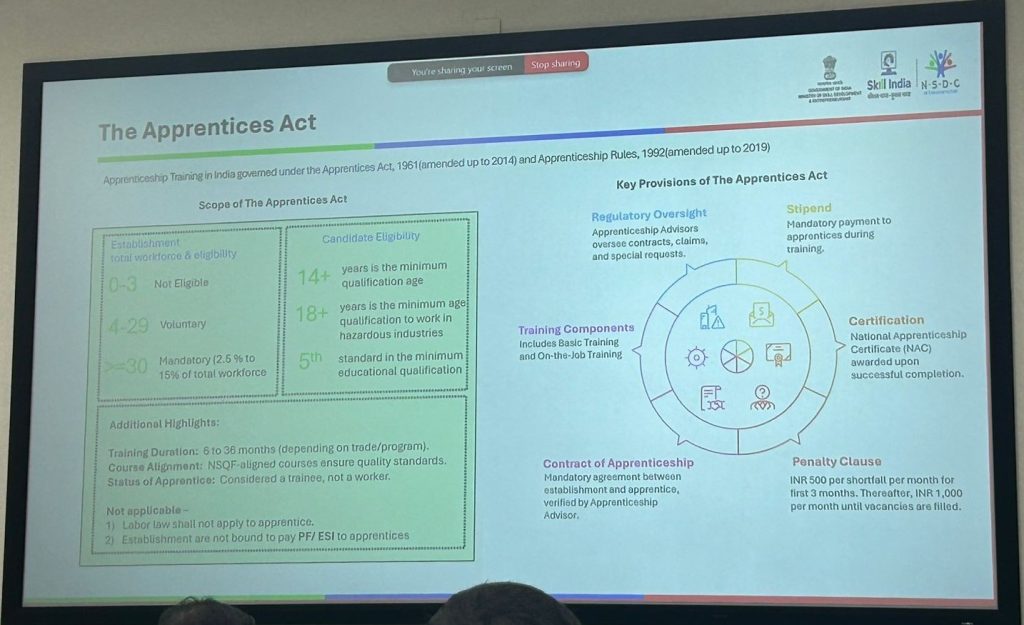
Regulatory Framework: The Apprentices Act
The workshop also highlighted the legal framework governing apprenticeships under the Apprentices Act, 1961.
Key provisions include:
- Mandatory stipend payment during apprenticeship training
- Formal apprenticeship contracts between employers and apprentices
- Regulatory oversight by apprenticeship advisers
- National Apprenticeship Certificate upon successful completion
Understanding these regulations helps institutions guide students toward structured and compliant apprenticeship opportunities.
Strengthening Industry–Academia Collaboration
PM-NAPS apprenticeship workshop was the importance of industry–academia collaboration in skill development. Such collaborations enable real-world learning experiences for students, stronger industry partnerships, enhanced employability outcomes & integration of practical skill development within academic programmes. These efforts align with India’s broader goal of building a future-ready workforce equipped with both academic knowledge and practical skills.
About ISBR Business School: ISBR Business School, located in Bangalore, India, is a premier institution dedicated to providing world-class education in business and management. Accredited by the NBA and recognized by the Association of Indian Universities and the Ministry of HRD, Government of India, ISBR has consistently been ranked as a platinum institute by AICTE-CII. With a diverse student body, a strong emphasis on industry collaboration, and a curriculum designed to foster innovation and leadership, ISBR Business School is committed to shaping the business leaders of tomorrow. The school’s robust placement record and partnerships with top global companies underscore its commitment to excellence and career readiness for its students