
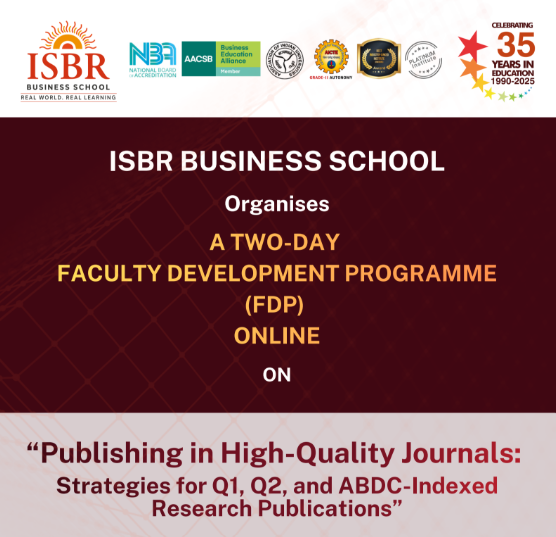
The Faculty Development Programme (FDP) on Research Publishing is becoming increasingly important for researchers, faculty members, and doctoral scholars seeking to publish in internationally recognized journals. Publishing in Q1 journals, Scopus-indexed journals, Web of Science (WoS), and ABDC-indexed journals requires more than quality research—it demands strategic journal selection, ethical publishing practices, strong academic writing, and an understanding of the peer-review process.
Recognizing this need, the ISBR Research Centre, Bangalore, successfully organized a Two-Day Faculty Development Programme (FDP) titled “Publishing in High-Quality Journals: Strategies for Q1, Q2, and ABDC-Indexed Research Publications” on 13–14 June 2026.
The programme empowered faculty members, PhD scholars, FPM scholars, academicians, industry researchers, and postgraduate students with practical insights into publishing impactful research in globally recognized journals.
About the Faculty Development Programme
The Faculty Development Programme was organized under the academic leadership of Dr. M. R. Jhansi Rani, Professor and Director – Research Centre, ISBR Business School and the programme was coordinated by Mr. Badhri Narayanaa P., Research Coordinator.
The sessions were conducted by Dr. Raja Sankaran, Associate Professor at Sri Sathya Sai Institute of Higher Learning (SSSIHL), Bengaluru, an accomplished academician with more than 35 years of experience in research, teaching, and industry.
The FDP focused on helping participants develop the knowledge and practical skills required for publishing in Scopus-indexed journals, Web of Science journals, and ABDC-listed journals.
Why Publishing in High-Quality Journals Matters
Publishing in reputed journals significantly contributes to:
- Academic career advancement
- Research visibility and citation impact
- Institutional reputation
- Global scholarly recognition
- Funding and collaborative opportunities
- Long-term research excellence
Participants learned that successful publication depends not only on producing quality research but also on selecting the right journal, maintaining publication ethics, and effectively navigating the editorial review process.
Research Writing and Journal Selection Strategies
Understanding Research Publication Standards
Dr. Raja Sankaran explained how high-quality publications influence academic growth and institutional rankings. Participants explored internationally accepted journal indexing systems, including:
- Scopus
- Web of Science (WoS)
- ABDC Journal Quality List
The session also explained journal rankings, impact indicators, citation metrics, and quality benchmarks commonly used by researchers worldwide.
Selecting the Right Q1, Q2 and ABDC Journal
One of the most valuable sessions addressed strategic journal selection.
Participants learned how to evaluate journals based on:
- Journal scope
- Indexing status
- Impact metrics
- Editorial quality
- Research fit
- Acceptance criteria
Special emphasis was placed on prioritizing publication quality over publication quantity, helping researchers avoid poor publication decisions.
Research Writing Framework for High-Impact Publications
The programme introduced a systematic research workflow covering:
- Problem identification
- Literature review
- Research gap analysis
- Hypothesis development
- Methodology selection
- Data analysis
- Manuscript writing
- Final journal submission
Interactive discussions enabled participants to connect these concepts with their own research projects and publication goals.
Peer Review Process and Publication Ethics
Understanding the Peer Review Process
Participants gained detailed insights into the complete publication cycle, including:
- Editorial screening
- Desk rejection
- Reviewer evaluation
- Revision process
- Resubmission strategy
- Final publication
Dr. Raja shared practical techniques for responding to reviewer comments professionally while improving manuscript quality.
Identifying Predatory Journals
One of the highlights of the programme was learning how to identify and avoid predatory journals.
Participants were introduced to common warning signs such as:
- Unrealistic publication timelines
- Aggressive email solicitations
- Misleading indexing claims
- Weak editorial standards
- Questionable peer-review practices
Practical methods were demonstrated for verifying journal authenticity using:
- ABDC
- ABS
- Scopus
- Web of Science
- DOAJ
This session significantly enhanced participants’ ability to publish in legitimate, internationally recognized journals.
Publication Ethics for Responsible Research
Academic integrity formed a major focus of the programme.
Key topics included:
- Research originality
- Authorship responsibilities
- Copyright considerations
- Ethical collaboration
- Plagiarism prevention
- Responsible manuscript submission
Participants understood that ethical publishing is fundamental to building long-term academic credibility.
Strategies for Successful Research Publication
Throughout the two-day FDP, participants learned several practical strategies to improve manuscript acceptance rates, including:
- Selecting journals aligned with research objectives
- Strengthening theoretical contribution
- Maintaining methodological rigor
- Writing clearly and academically
- Addressing reviewer feedback constructively
- Building a long-term publication portfolio
These strategies provide researchers with a structured roadmap for publishing consistently in high-impact journals.
ISBR Research Centre’s Commitment to Research Excellence
The successful completion of this Faculty Development Programme reflectsISBR Research Centre’s continued commitment to fostering a strong research ecosystem.
The institution extends sincere gratitude to Dr. Raja Sankaran for sharing his extensive expertise in academic publishing and acknowledges the leadership of Dr. M. R. Jhansi Rani for driving research excellence through impactful academic initiatives.
The enthusiastic participation of faculty members, researchers, academicians, and scholars further contributed to the programme’s success, reinforcing ISBR’s vision of promoting ethical, impactful, and globally recognized research.
About ISBR Business School: ISBR Business School, located in Bangalore, India, is a premier institution dedicated to providing world-class education in business and management. Accredited by the NBA and recognized by the Association of Indian Universities and the Ministry of HRD, Government of India, ISBR has consistently been ranked as a platinum institute by AICTE-CII. With a diverse student body, a strong emphasis on industry collaboration, and a curriculum designed to foster innovation and leadership, ISBR Business School is committed to shaping the business leaders of tomorrow. The school’s robust placement record and partnerships with top global companies underscore its commitment to excellence and career readiness for its students